When planning a display for a meeting room, control room, corporate lobby, or retail environment, buyers often compare fine-pitch LED displays with commercial LCD displays.
Both technologies can deliver high-quality visual content, but they differ in screen size, resolution, installation flexibility, maintenance, and overall project cost.
So, which solution is right for your project?
In this guide, we compare fine-pitch LED displays with commercial displays and explain what to consider when choosing an indoor LED display for professional applications.
What Is a Fine-Pitch LED Display?
A fine-pitch LED display is a direct-view LED screen with a small distance between adjacent pixels. Pixel pitches typically range from P0.9 to P2.5 for many indoor applications.
Unlike an LCD display, which uses a backlight or self-emissive LCD panel system to produce images, a direct-view LED display uses LEDs to generate the image directly.
Fine-pitch LED technology is commonly used for:
Corporate meeting rooms and boardrooms
Control rooms and monitoring centers
Conference and presentation spaces
Reception areas and corporate showrooms
High-end retail and commercial environments
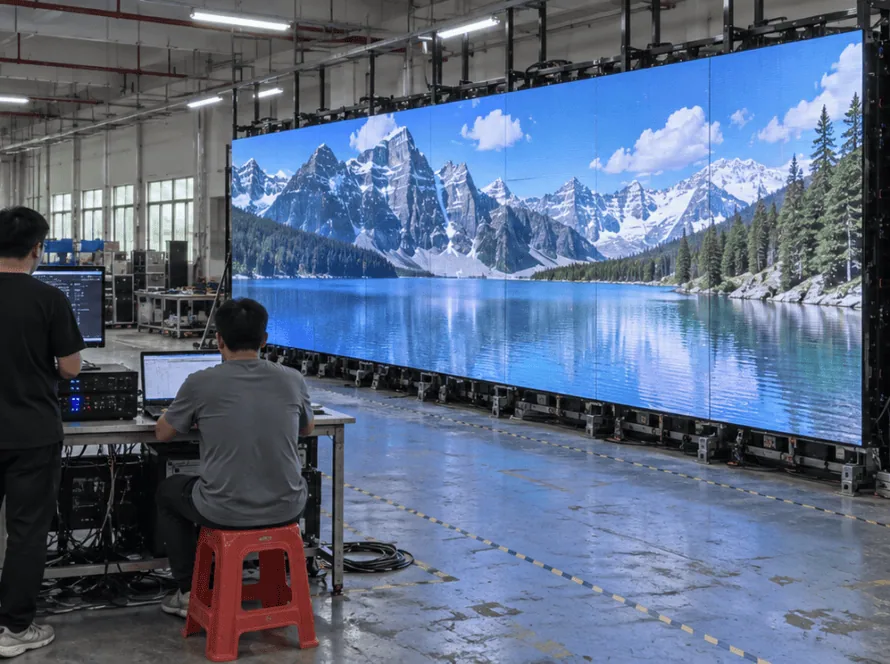
A fine-pitch LED video wall can be assembled from multiple cabinets to create a large display surface with flexible dimensions and no conventional LCD panel bezels between modules.


Fine-Pitch LED vs Commercial LCD Display: Key Differences
The right choice depends on the viewing distance, screen size, content, installation environment, and budget.
1. Screen Size and Installation Flexibility
Commercial LCD displays are available in standard panel sizes. For larger video walls, multiple panels are typically arranged together, and visible bezels may appear between them.
A fine-pitch LED video wall is assembled from modular LED cabinets. It can support large, seamless display surfaces and offers greater flexibility in overall screen dimensions.
For projects requiring a very large image area, custom screen proportions, or a visually continuous display, fine-pitch LED is worth considering.
2. Resolution and Viewing Distance
Resolution is an important factor when choosing a display, but it should not be considered separately from screen size and viewing distance.
For fine-pitch LED displays, a smaller pixel pitch generally means more pixels within the same physical area, allowing finer image detail at closer viewing distances.
Typical indoor pixel pitch options include:
P0.9–P1.2: Suitable for applications requiring very fine image detail and close viewing.
P1.5–P1.8: A practical option for many premium meeting rooms and professional display environments.
P2.0–P2.5: Often considered for larger indoor screens where viewers sit farther away.
These are general selection guidelines rather than fixed viewing-distance rules. The final choice should consider the actual screen dimensions, content, and audience position.
For a more informed decision, buyers should evaluate the pixel pitch, total pixel resolution, and viewing distance together.
3. COB and GOB Technology
COB and GOB are two technologies used to improve the surface protection of certain LED display products.
COB (Chip on Board) mounts LED chips directly onto a substrate and applies a protective encapsulation process. Depending on the design, COB displays can provide a compact pixel structure and a more integrated display surface.
GOB (Glue on Board) applies a transparent protective layer over the LED module surface. It can help improve resistance to physical contact and certain types of surface damage.
Both technologies have different implementation methods and product characteristics. Their suitability depends on pixel pitch, encapsulation quality, maintenance requirements, and the intended application.
When comparing a fine-pitch LED video wall, ask the manufacturer about surface protection, repair procedures, image performance, and long-term serviceability rather than choosing solely by the COB or GOB label.
4. Front Service and Maintenance
Front service is an important feature for indoor LED installations where rear access is limited.
With a front-maintenance design, technicians can access designated modules or components from the front of the screen, depending on the product structure.
This is especially useful for:
Meeting rooms with limited rear clearance
Built-in commercial display installations
Control rooms with space constraints
Before purchasing, confirm which components can be removed from the front, what tools are required, and whether module replacement can be completed without dismantling the entire screen.
5. Die-Casting Aluminum Cabinet Design
Cabinet design affects installation accuracy, structural stability, maintenance, and the overall performance of a fine-pitch LED display.
Die-cast aluminum cabinets can provide precise cabinet dimensions and a rigid structure when properly manufactured. Their thermal performance and weight depend on the cabinet design and the complete display configuration.
For professional indoor installations, buyers should consider cabinet flatness, alignment, assembly tolerances, service access, and compatibility with the selected pixel pitch.
These factors become increasingly important when multiple cabinets are assembled into a large, seamless LED video wall.


Fine-Pitch LED vs Commercial Display: Comparison Table
| Feature | Fine-Pitch LED | Commercial LCD |
|---|---|---|
| Screen size | Flexible modular dimensions | Standard panel sizes |
| Large video walls | Seamless cabinet-based surface | Panel bezels may be visible |
| Pixel pitch or resolution | Depends on LED pixel pitch and screen size | Depends on native panel resolution |
| Close viewing | Suitable with an appropriate fine pixel pitch | Suitable at the panel’s intended viewing distance |
| Maintenance | Front or rear service, depending on design | Usually serviced as individual panels or assemblies |
| Initial investment | Often higher for fine-pitch configurations | Often lower for standard display sizes |
| Best suited for | Large seamless walls and custom installations | Standard signage, individual displays, and smaller video walls |
Actual pricing and performance depend on screen size, product specifications, installation requirements, and supplier.
How to Use an LED Screen Resolution Guide
When selecting a display, do not focus on pixel pitch alone. The total pixel resolution determines how much image detail can be displayed across the screen.
For an LED display, the approximate pixel dimensions can be calculated by dividing the physical screen dimensions by the pixel pitch.
For example, a 3.2m-wide P1.25 LED display has approximately:
3,200mm ÷ 1.25mm = 2,560 pixels horizontally.
This is an approximate calculation; the final pixel resolution depends on the actual module and cabinet configuration.
A smaller pixel pitch provides more pixels within the same physical screen area, but it can also increase the project cost. The best option is the one that provides sufficient detail for the intended viewing distance and content.
When planning an LED video wall, confirm the required resolution, aspect ratio, video processor compatibility, and input signal specifications before placing an order.
Which Display Is Better for Your Project?
Choose a fine-pitch LED display if your project requires a large, seamless screen, customized dimensions, or a premium visual presentation.
Consider a commercial LCD display if you need a standard screen size, straightforward signage, or a more budget-conscious solution for a smaller display area.
For fine-pitch LED projects, P0.9–P2.5 provides a range of options for different viewing distances and screen sizes. COB or GOB technology, front service, and die-cast aluminum cabinet design can also influence product selection and maintenance planning.
The most suitable configuration should be based on your application, viewing distance, installation conditions, and total project budget.
Looking for an Indoor LED Display Manufacturer?
Choosing the right supplier is an important part of a successful LED display project.
When evaluating an LED display factory direct solution, ask about pixel pitch options, cabinet design, front-service access, LED component quality, control systems, warranty terms, and technical support.
A reliable manufacturer should be able to recommend a configuration that meets your project requirements and provide clear technical specifications for evaluation.
ZILANG LED provides LED display solutions for professional indoor and outdoor applications. Contact our team to discuss your project, compare suitable pixel pitches, and request a customized quotation.
Planning a fine-pitch LED video wall? Contact ZILANG LED to find the right display configuration for your project.